Toyoda Gosei
Implementation on a single production hall saves Toyoda Gosei over 3 000 000 CZK annually.
“We spent years trying to develop our own data collection system, but even the smallest change would take a month. MES SoftLi was implemented in less than 24 hours. Changes and requests are also processed quickly – we’ve yet to come up with an idea that couldn’t be implemented soon. The system is highly flexible, allowing nearly every component to be customized.”
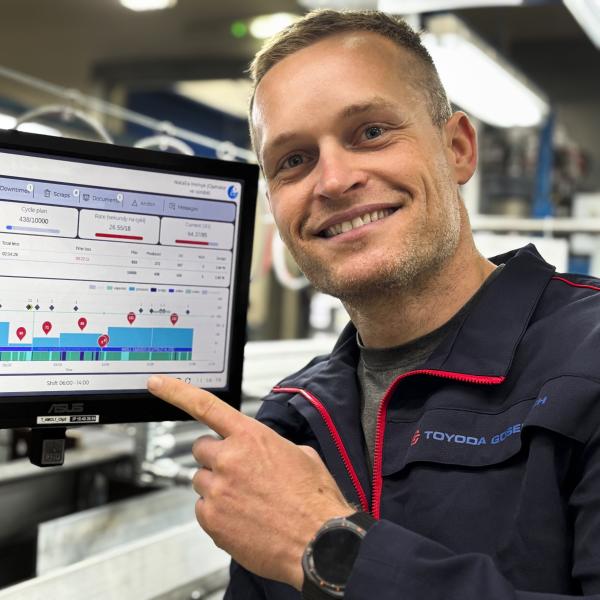
Lukáš Paukner
Smart Operations & Sustainability manager, Toyoda Gosei Czech
About the client
The Japanese company Toyoda Gosei Czech is a leading manufacturer of plastic, polyurethane, and rubber automotive components that enhance vehicle comfort. It has been active in the Czech market since 2001.
Its customers include Toyota, Suzuki, the Volkswagen Group and others. The company has branches on every continent. The Czech branch operates across four production halls, producing:
safety components – primarily airbags
functional parts – fuel systems, brake hoses, engine and airbag covers, steering wheels including stitching, and other interior components
rubber seals for car doors and windows
The production portfolio covers almost all technologies except coating: assembly, injection molding, extrusion, painting, stamping, and manual workstations.
Before implementation: nothing but Excel
“As in most factories, we relied on Excel. Partly because Excel is very common in Japanese manufacturing environments,” describes Lukáš the initial situation.
The biggest problem appeared during shift changes:
“Sixty operators handed over their reports to the supervisor ten minutes before the end of the shift. He couldn’t process them in time, so the incoming shift leader had to take the papers and manually re-enter the data. And since it wasn’t his shift or his team, he had little motivation to check the accuracy of the information.”
The result?
Data from the night shift only became accessible around 7:30 a.m. According to him, each shift lost 36 minutes due to downtime, which adds up to 108 minutes per day.
“Detection of issues, their analysis and implementing countermeasures all occurred with considerable delay,” comments Lukáš.
Why did they opt for MES Softli?
Toyoda Gosei contacted six companies and compared them based on their own criteria:
Compatibility with all production equipment across the halls
Integration with the ERP system JD Edwards and existing information systems
Support for using the company’s own hardware
Features such as digital forms, real-time visualization, Andon systems, maintenance module, and energy consumption measurement
Flexible licensing and server solutions
Excellent price/performance ratio
“SoftLi emerged as the best choice from this shortlist. We were impressed by the system’s flexibility – as a large company with many requirements, we wanted to be able to customize many aspects ourselves, which other vendors did not offer,”
explains Lukáš.
However, he first had to convince the Japanese management.
“Being able to first explore the demo and then test the system on four production machines was extremely valuable,” recalls Lukáš.
When he approached top management with the investment request, he emphasized that the system could be deployed within 24 hours with immediate benefits.
„Even though they didn’t believe it, I was given a chance to prove them wrong. The very next day we showed them the collected data, and they couldn’t understand how it was even possible,” says Lukáš.
ROI?
The first 2,5 million CZK invested (approx. 160 licenses) paid for itself within two years.
The next halls are projected to reach full ROI within just a few months.
Employee adoption: From resistance to proactivity
“In the beginning, employees feared we’d be breathing down their necks. They even disconnected cables to prevent machine monitoring,” admits Lukáš.
Communication was the key.
For the team leaders, it was essential to explain that MES wouldn’t take their jobs away – it would actually make their work easier. Today, all they need to do is check the production dashboard; they immediately see what is running smoothly and what needs attention, and instead of constantly rewriting data from Excel, they can focus on assigning specific tasks to their teams.
Operators quickly embraced the gamification aspects – Toyoda within MES SoftLi generates the data needed for shift- and hall-level competitions. Each operator receives points according to productivity, monitors the ongoing standings, and aims to surpass their peers.
“Employees are now fully accustomed to MES SoftLi and have no problems using it. They even frequently propose what could be improved,” notes Lukáš with satisfaction.
Toyoda continues to push innovation forward and is gradually implementing smart operations into production.
For example, in the picking system the operator must complete five to six steps in a specific order. MES SoftLi monitors the entire process through sensors. If the operator skips any step, the system marks the process as incomplete and alerts them to the mistake. This gives operators confidence that everything has been done correctly.
Key implementation results
8 % improvement in production efficiency
For Japanese, lean management and Kaizen principles are almost sacred. Last year, the goal was to increase productivity by 8 % – and with MES SoftLi, the team achieved it. This year, they set the same target again, they are well on their way to meeting it once more,“ believes Lukáš.
Immediate problem detection
“Today we have four display boards in a single room, showing the entire material flow in real time. We can see all production data instantly, allowing us to react immediately.”
More accurate calculations and norms
“The integration of MES SoftLi with the JD Edwards ERP system allows operators to see a direct comparison between expected and actual performance on their terminals.”
“When no one is able to meet the set standard, we know it’s time to adjust it. We use this data to plan budgets and determine the number of operators required for each job."
Reducing defects on automated lines by 3%
“On our automated lines, operators no longer need to monitor, analyze or manually record quality – the machines handle it all. This has reduced defect rates by 3 %, saving roughly 250 000 CZK per month.”
Energy savings and sustainability
Energy savings aren’t limited to production processes. Thanks to the Energy Tracker module, Toyoda has significantly reduced energy costs.
‘I really appreciate the Energy Tracker. I’m responsible for sustainability, and it allows me to easily calculate the carbon footprint. I can immediately see how much energy it takes to produce a specific part,’ explains Lukáš.
As part of overall efficiency improvements, energy monitoring is linked to additional processes:
A timer starts at the end of production
After the timer expires without new activity, an Andon notification is sent via SMS
The shift leader must either explain or switch off any active heating
Some processes, like heating, are not automatically or remotely switched off because molds may need to remain warm during dry ice maintenance.
“Remote control allows us to shut down energy-intensive processes like fume extraction, which can consume 11 kWh, whenever production stops. This saves a lot of money. Lights that are often left on by employees are handled the same way.”
The Energy Tracker module also simplifies ESG reporting considerably.
Inspiration for other offices
The results of MES SoftLi implementation were so impressive that the Czech branch will present them at the company’s global summit.
And there’s plenty to showcase.
“MES SoftLi’s remarkable flexibility allowed us to create a highly customized and comprehensive system. So far, every idea we’ve had has been achievable in collaboration with SoftLi. The only downside? Our team now expects anything is possible and constantly presents us with new requests,” nods Lukáš Paukner with a smile.
